P3 Pallet3D editorial team7 min readPublished: 29 October 2026
Multi-drop unloading: how to arrange cargo according to delivery order?
Plan the placement of goods in delivery order and reassess cargo stability after each unloading.
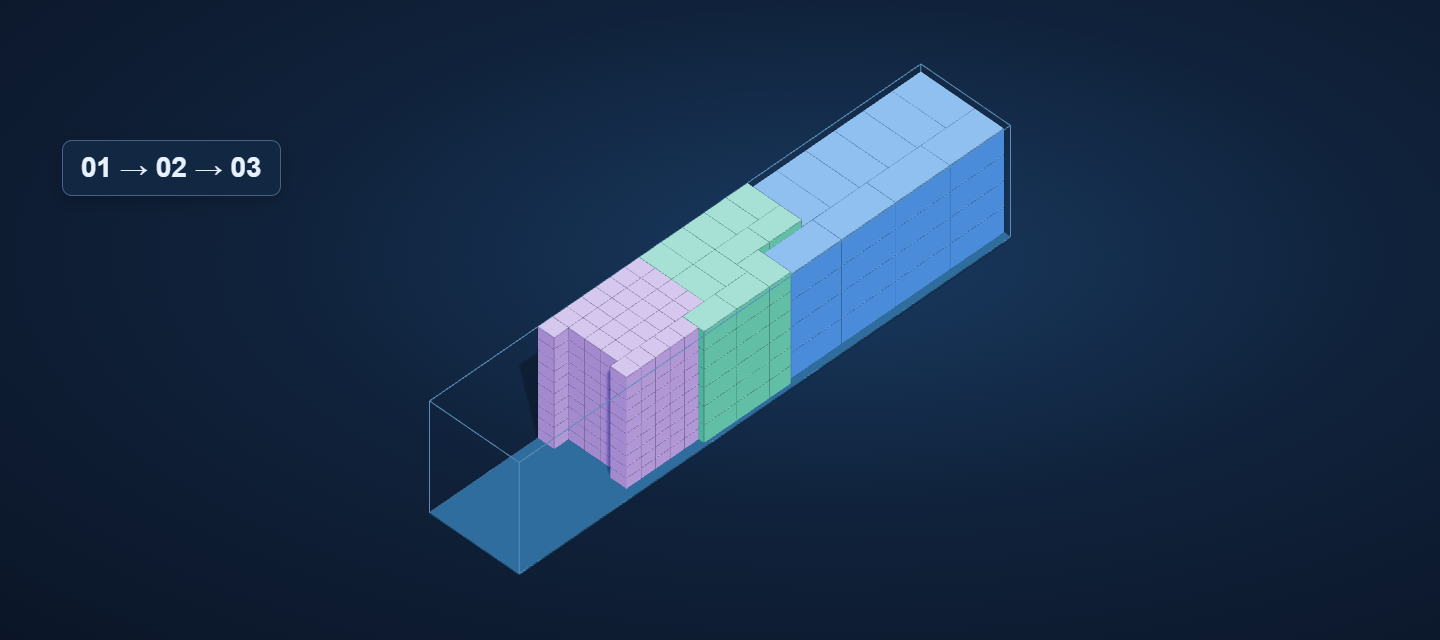
First determine the actual order of stops and how access to the vehicle is provided at each point. Then arrange the batches in reverse order of their release: goods for the first recipient should be accessible from the unloading side, while cargo for later stops usually goes deeper inside. This is the starting point, not a rigid scheme - the layout must also take into account weight distribution, stability, securing, dimensions, and the unloading method.
In this article
The batch for the first stop is placed at the actual unloading zone, provided the overall layout allows it.
Cargo for later points is usually arranged deeper so it does not block earlier deliveries.
Side access, stacking, and different dimensions can change the standard arrangement order of batches.
Each batch must be assigned to a stop, labeled, and checked in the actual layout before departure.
Unloading order and the overall loading plan
The overall loading plan answers the question of how to arrange goods in the vehicle. In multi-drop transport, a second condition applies: at each stop, it must be possible to release the correct batch without removing or shifting goods intended for later recipients.
That is why it is not enough to confirm that all units fit in the cargo space. You need to trace the route point by point and assess access to each batch at the moment it is to be released. The layout may use space well while still blocking the first delivery if a batch intended for a later stop stands in front of its goods.
It is worth linking each part of the cargo clearly to a specific delivery point. Such assignment organizes picking, labeling, and vehicle-side checks. Broader issues related to cargo placement are discussed in the material on preparing a loading plan.
Planning from the end of the route: a practical heuristic
Start planning with the actual sequence of stops, not with the picking order, order numbers, or recipient names. Only after the route is established do you know which batch must leave the vehicle first and which will remain in it the longest.
The typical rule is as follows: batches intended for later delivery points are placed deeper inside, while goods for earlier stops are placed closer to the place from which unloading will take place. When unloading from the rear of the vehicle, this usually means that the first delivery is located on the rear-access side, the next one behind it, and the last one deepest inside. This way, after the first batch is delivered, the path to the next one becomes clear.
This rule does not work automatically in every situation. Side access can completely change the loading direction. Another variant may also be needed because of dimensions, stacking possibilities, cargo properties, weight distribution, or how work is carried out at the delivery location. Therefore, you should not assume that every pallet for the first stop must stand by the doors - first you need to assess the entire layout and the actual way it will be released.
The delivery order must not violate requirements regarding stability and cargo securing. The cargo should be planned and secured against shifting and tipping during transport. When the arrangement of what remains in the vehicle changes during unloading, the remaining cargo must be assessed again according to the appropriate procedures.
Example route with several delivery points
Let us assume a scenario with three consecutive stops: A, B and C. Each recipient has its own clearly separated batch. The example assumes unloading from one access zone and no restrictions that would require a different arrangement. This is not a universal layout for every vehicle.
Route point
Batch
Position relative to the access point
Purpose of arrangement
First stop
A
Closest to the unloading zone
Release the batch without moving B and C
Second stop
B
Behind batch A
Gain access after A is released
Third stop
C
Deepest inside
Release the batch after A and B are unloaded
In this variant, batch A is accessible at the first stop. After it is released, access to B opens up, and after B is unloaded - access to C. The most important thing is not the arrangement order in the diagram itself, but the ability to actually remove each batch at the time of its delivery.
A blockage will arise if B or C is positioned in front of A in the direction of actual access. The problem will also occur if A is labeled correctly but there is no route that allows it to be separated and removed. A similar obstacle is created by stacking when the cargo for a later stop stands on a batch to be delivered earlier. Different dimensions may additionally make it impossible to move one unit away without interfering with the others.
Planning access to batches step by step
Prepare a list of delivery points and assign the correct batch to each one. Goods for different recipients should be clearly separated, especially when they include similar assortments or similar load units.
Confirm the current order of stops. Take into account route changes, the order of serving recipients, and any arrangements affecting which batch is to be released earlier.
Determine the release priority and the actual access zone. Establish whether unloading will take place from the rear, from the side, or in another way available at a given point. It is to this zone that the concepts of “closer” and “deeper” refer.
Check the vehicle and cargo limitations. Assess dimensions, stacking possibilities, weight distribution, stability, and securing requirements. The delivery order is important, but it must not lead to an arrangement that is improper from the perspective of these conditions.
Carry out an access check for the successive stops. First, check whether the batch for the first recipient can be released without moving later deliveries. Then assume it has been removed and assess access to the next batch in the same way.
Label batches according to the delivery point or release order. The marking should allow the warehouse and driver to quickly identify the correct goods without guessing during picking, checking, and unloading.
Compare the finished layout with the current route immediately before departure. Check the actual arrangement after loading is complete, not just the original plan. If the stop order or layout changes, the access to the batches remaining in the vehicle must be reassessed.
In matters of securing and fastening, you should act according to the procedures in force in a given organization and with the involvement of competent people. This topic requires separate assessment, because the accessibility of batches does not determine the correctness of securing the entire cargo.
Errors that make multi-drop unloading difficult
The most common mistake is blocking the goods for an earlier recipient with a batch intended for a later stop. During loading, the arrangement may look correct, especially when the labels are clear. Only at the delivery location does it become apparent that the path to the correct goods is occupied and the remaining units have to be moved.
The second mistake is planning according to the assumed, rather than the actual, unloading direction. A batch placed at the rear of the vehicle will not automatically be accessible when the recipient unloads from the side. Before loading, you therefore need to confirm where from and how unloading will take place, instead of relying on habits from previous routes.
Uncontrolled stacking also causes problems. Goods for a later stop placed on a batch for an earlier recipient block its release, even when both batches are correctly labeled. Units of different dimensions can have a similar effect by obstructing the maneuvering path or making it impossible to separate the correct batch.
Route changes after loading are a separate issue. A new delivery order may reverse the priorities of the batches and cause an originally correct layout to no longer provide access. In such a situation, the layout must be reassessed instead of assuming that the earlier plan still matches the route.
Checklist before handing the vehicle over for the route
The order of delivery points matches the current route.
Each batch is clearly assigned to a recipient and labeled.
The batch for the first stop is accessible from the actual unloading side.
Later deliveries do not block the release of earlier batches.
After the hypothetical release of the first batch, the next one remains accessible.
The layout takes into account dimensions, stacking, weight distribution, stability, and securing requirements.
The actual layout after loading has been compared with the plan and the route.
Before departure, compare the cargo arrangement variant with the delivery order in Pallet3D. The calculator lets you enter cartons or rolls with dimensions and weight, arrange cargo on pallets and in a trailer or container, and view the result in an interactive 3D view. See how to plan vehicle loading.
Plan your load in 3D
Enter your box sizes and Pallet3D shows the optimal layout in interactive 3D - 5 days free.