P3 Pallet3D editorial team7 min readPublished: 21 October 2026
Cargo securing in road transport: straps, corner protectors and rules according to EN 12195
Choose straps, corner protectors and other securing devices according to the mass and geometry of the load, using EN 12195 and proper lashing points.
Start selecting securing equipment with the mass and geometry of the cargo, its stability, packaging, friction, free spaces, and the strength of the lashing points and bodywork. Straps, corner protectors and other devices serve different functions; the mere number of straps does not prove that the cargo is properly secured. Below I explain how to relate the arrangement to EN 12195 and check it before departure.
In this article
Selecting securing equipment requires assessing the cargo, the vehicle and the actual loading arrangement.
LC and STF from the strap label describe different parameters and cannot be used interchangeably.
A corner protector protects the edge and distributes pressure, but it does not replace proper securing.
Anti-slip mats, blocking, spacers and nets serve different functions in cargo securing.
Pre-departure inspection should also include lashing points and free spaces.
What determines effective cargo securing
The rules for securing loads in road transport begin with risk assessment, not with choosing specific equipment. A stable, compact stack of boxes places different demands than a tall load prone to tipping, goods of irregular shape, or packaging that may be crushed by a strap.
You need to check the mass and distribution of the goods, their contact with the floor, free spaces, the possibility of resting against parts of the vehicle, and the available lashing points. The permissible load on the bodywork and lashing points is also important. Directive 2014/47/EU requires that permissible axle loads be taken into account, as well as the strength of the lashing points and bodywork (source: Directive 2014/47/EU, Annex III).
Safe cargo securing in transport is therefore a property of the entire system. A strap, blocking arrangement or spacer can only work properly if it cooperates with the cargo, the floor and the structure of the load space.
Load straps - use and limitations
Synthetic fibre load straps are covered by EN 12195-2. They may be used, among other things, for tie-down or direct lashing, but the way they are routed and their role in the arrangement must correspond to the adopted securing method. A strap should not be equated with blocking: blocking limits movement by bracing the cargo against sufficiently strong elements, while a strap transfers forces through tension and lashing points.
When selecting a strap, read its label. LC means lashing capacity, and STF means the standard tension force obtained by the tensioner. These are different parameters, used depending on the securing method; one must not be substituted for the other. The calculation according to EN 12195-1 requires at least knowledge of the cargo mass, coefficient of friction, strap angles, LC or STF parameters, lashing points and bodywork load capacity.
Check the strap label and match the method to the parameters indicated by the manufacturer.
Assess the condition of the webbing, stitching, hooks and tensioner before use.
Make sure that the lashing points and bodywork can carry the loads resulting from the chosen solution.
Do not increase strap tension as a substitute for blocking, filling empty space or stable stowage of the goods.
A strap routed over a sharp or yielding edge can damage the packaging, and a damaged edge can change the behaviour of the entire stack. The strap route should stabilise the cargo, not deform it.
Corner protectors and other edge protection devices
A protective corner protector distributes strap pressure over a larger area. In practice, it can reduce the risk of crushing, abrasion or damage to the corner of a box and other delicate packaging. It is particularly useful where the strap changes direction at the edge of the cargo or presses on a small area.
Protective transport corners must be matched to the geometry and strength of the packaging and placed exactly where the pressure occurs. A corner protector does not automatically increase the lashing capacity of the strap, does not replace label checking, and does not secure the cargo against shifting into free space. Its function is to protect edges and distribute pressure properly.
EN 12195 as a reference point when planning securing
Annex III of Directive 2014/47/EU adopts securing forces equal to 0,8 of the cargo weight forward and 0,5 sideways and against the direction of travel. These are values for assessing the effectiveness of securing, not a conversion factor for the number of straps. The basis for calculations is the specific mass, geometry of the cargo and the securing arrangement used.
EN 12195 does not give a universal answer to how many straps should be used for a pallet or the whole load. EN 12195-1 concerns the calculation of lashing forces, EN 12195-2 synthetic fibre straps, EN 12195-3 chains, and EN 12195-4 steel wire ropes. Directive 2014/47/EU indicates these parts of the standard as a reference for the methods and equipment used in cargo securing (source: Directive 2014/47/EU, Annex III).
In practice, the assessment according to EN 12195-1 should result from the actual arrangement, not from the type of goods alone. Two similar loads may require different solutions if they differ in mass, coefficient of friction, height, position in the vehicle, strap angles, number of available lashing points or the presence of free spaces.
The Directive lists blocking and direct lashing or tie-downs as securing methods. The choice of method should be related to the documentation for the equipment used, the vehicle parameters and the calculation for the given case. A general statement that the load has been strapped down does not confirm that the securing is correct.
When to supplement straps with other securing devices
Methods of securing loads in transport often combine several devices, because each solves a different problem. First it should be determined whether the main risk is slipping, tipping, movement into a void, loose items, or packaging damage caused by the strap.
Problem to reduce
Possible role of the securing device
Load slipping relative to the floor
Anti-slip mats can help reduce slipping if they are selected and used according to the instructions.
Load movement into free space
Blocking, spacers or suitable filling can limit the available movement.
Movement of smaller units
Transport securing nets can limit the movement of elements when this matches their intended use.
Strap pressure on the corner
A corner protector can distribute pressure and protect the packaging.
These devices are not interchangeable. A mat will not fill empty space, a net will not replace calculated lashing, and a corner protector will not stabilise a tilting stack. Before closing the vehicle or container, it must be assessed whether the cargo position allows movement longitudinally, laterally or backwards.
Pre-departure lashing check - practical checklist
Compare the actual loading arrangement with the adopted securing method. A change in pallet order, stack height or the number of units may change the securing assumptions.
Check the stability of the stacks, the support of the cargo and contact with the floor. Remove elements that may shift, tilt or fall.
Assess free spaces and the possibility of cargo movement in any direction.
Inspect the labels, condition and correct routing of the straps, as well as the condition of the tensioners, hooks, lashing points and edge protection.
Confirm that the use of mats, spacers, nets and other devices complies with their instructions and with the adopted securing method.
Verify whether the applied solution takes into account the load capacity of the bodywork, lashing points and permissible axle loads.
Example of assessing a palletised load before transport
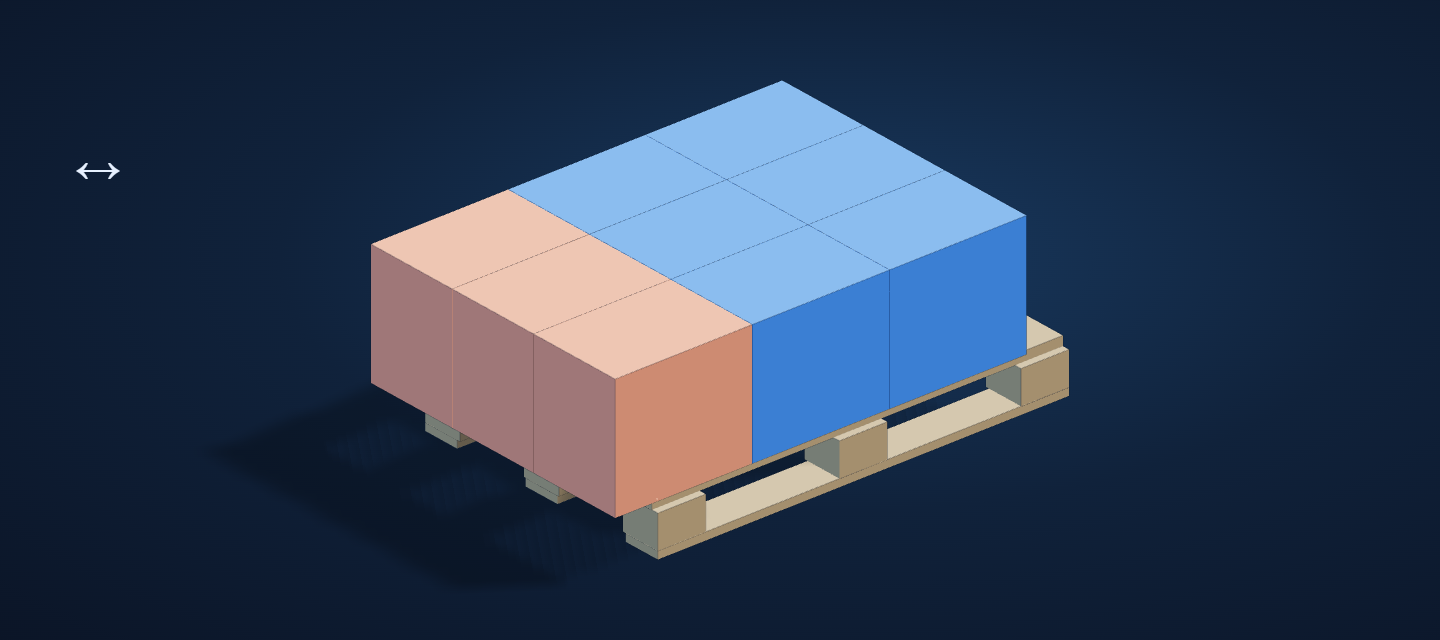
Suppose there is a stack of boxes on a pallet, and after loading there is free space in front of the load unit. First it is assessed whether the boxes form a stable stack and whether their corners can withstand strap pressure. Then it is checked whether the pallet or the entire stack may move forward, sideways or into the free space.
If the strap runs over vulnerable corners, edge protection can be considered as packaging protection. If the main problem is free space, a solution limiting movement is needed, not simply tighter strap tension. Only after determining the geometry of the load, the strap parameters from the label, the lashing points and the support conditions can the method be assessed in accordance with the requirements applicable to that case.
A plan for the arrangement of boxes and pallets can help to identify empty spaces and geometric collisions in advance. However, it does not replace lashing calculation, stability checking, mass and axle load limits, or assessing the compliance of the securing devices used.
Plan your load in 3D
Enter your box sizes and Pallet3D shows the optimal layout in interactive 3D - 5 days free.