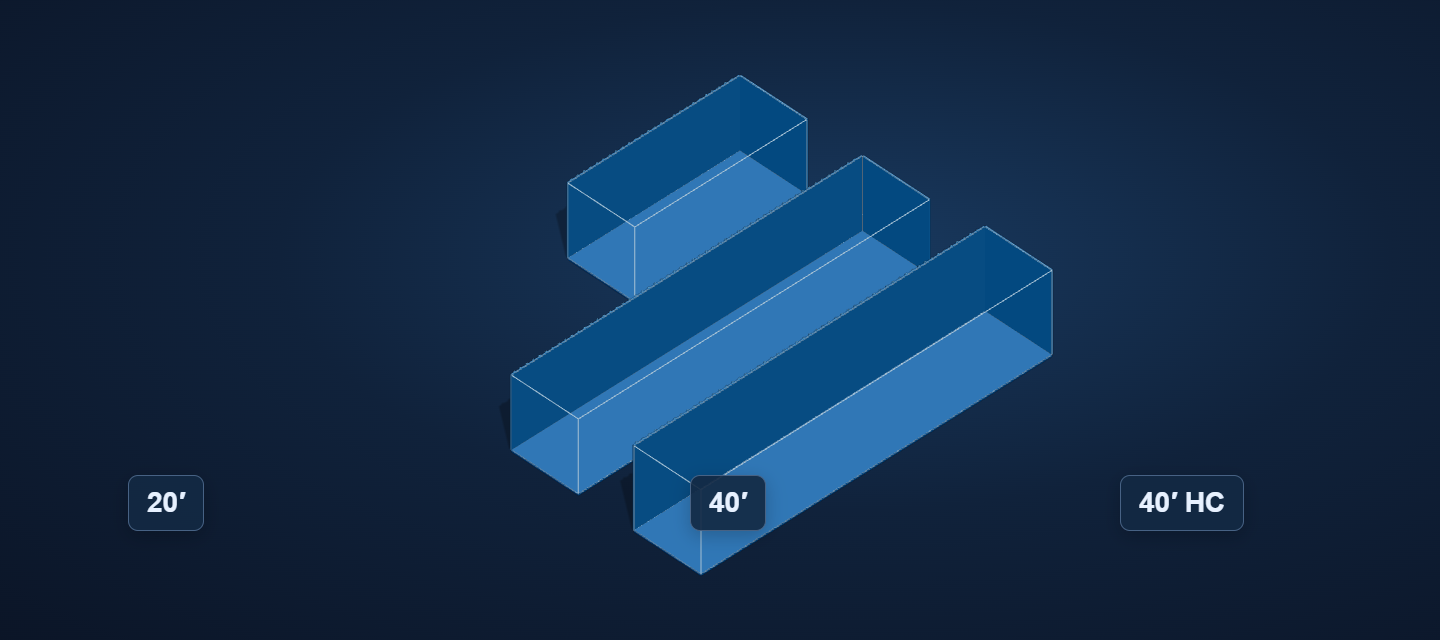
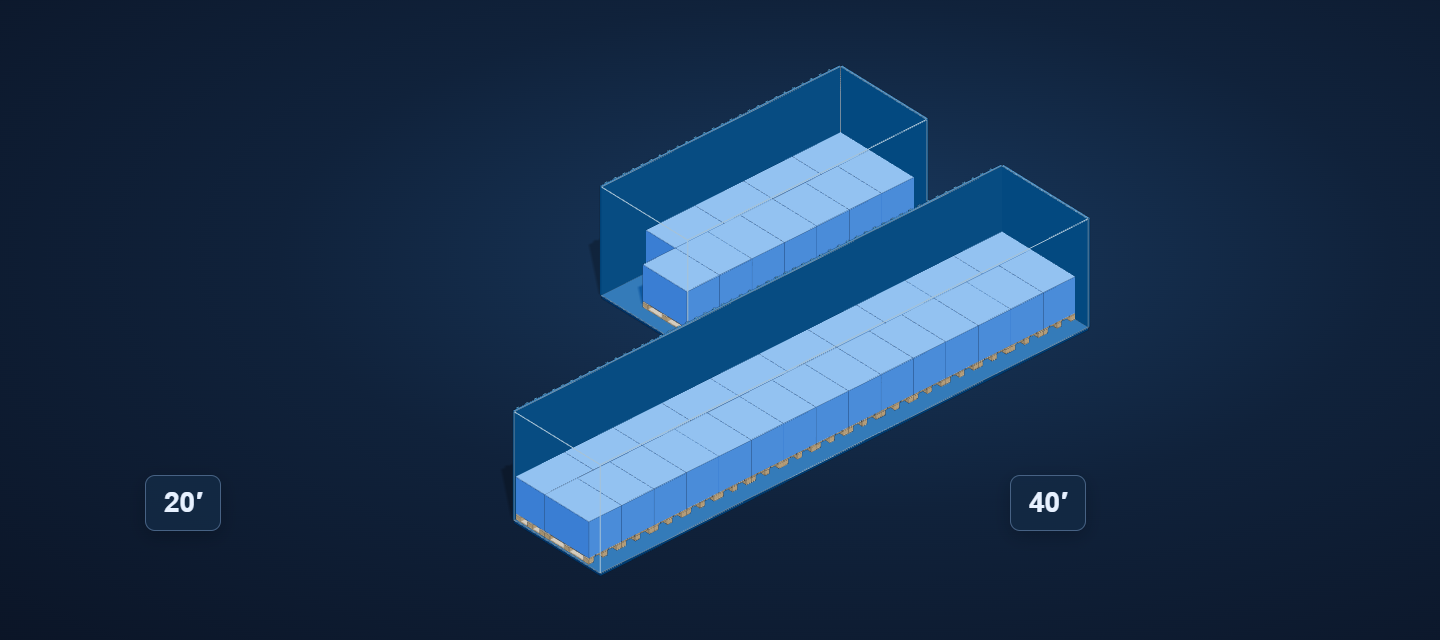
Volume describes the space occupied by a load unit determined by its external dimensions. It may refer to a carton, a roll, a bundle, a pallet, or another unit handed over for transport. For calculations, you should use the actual dimensions after packing, preparing for shipment, and placing on a transport base, if it forms part of the unit.
Before booking freight, compare pallet layouts in the container loading calculator. For further worked examples, see the guide Shipping container dimensions 20', 40', 40'HC.
Volume [m³] = length [m] × width [m] × height [m]
The dimensions must be written in the same unit. When length, width, and height are given in meters, the result is obtained in cubic meters, i.e. m³. Mixing meters with centimeters without first standardizing the units leads to an incorrect result.
Hypothetical example: a package with dimensions 0,5 m × 0,4 m × 0,3 m, assumed solely for the purposes of the example, has a volume of 0,06 m³, because 0,5 × 0,4 × 0,3 = 0,06. For a batch of four identical packages, assumed in the same example, the total is 0,24 m³: 0,06 m³ × 4 = 0,24 m³.
For a mixed batch, each type of unit should be calculated separately: first the volume of one piece, then the result multiplied by the number of pieces of that type. Finally, the obtained values are added together. Such a result is useful for determining the total cargo volume, but it still does not take its spatial arrangement into account.
What data to collect before planning loading
The loading plan should be based on data about ready transport units, not on the dimensions of the product itself before packing. Carton, foil, pallet, protective corners, or protruding elements can change both the dimensions and the way the goods are positioned.
First divide the batch into groups of units with the same dimensions and the same placement conditions. For each group, record the length, width, height, number of pieces, and weight. Then determine whether the units can be rotated, stacked, and placed next to each other without creating unusable gaps.
You also need to determine whether the cargo has an irregular shape, whether it has protruding elements, and whether specific batches must be accessible in a certain order. Information needed for the adopted securing method is also important. Only a complete set of such data makes it possible to move from the sum of m³ to a real arrangement variant.
The space for which the plan is being created should be described separately: its length, width, usable height, and restrictions resulting from access and loading openings. Usable height means the height that can actually be used for the given units and their method of arrangement - it should not be equated with the volume of the space itself.
More tips on collecting information can be found in the article about preparing a loading plan.
Volume, area, pallets, and loading meters - four different measures
These concepts answer different questions. Using them interchangeably may lead to an incorrect assessment of the space needed for transport.
Two batches may have identical volume and yet require a completely different arrangement. One may be tall and take up a small base, while the other may be low but spread widely across the floor. In the first case, the usable height may be the limiting factor; in the second, the available floor area.
The number of pallets is not enough to assess the space, because units may differ in dimensions, height, weight, and placement conditions. Similarly, loading meters do not replace volume calculation: they refer to the length of floor occupied, not to space in three dimensions.
Why volume alone does not guarantee cargo fit
Volume is a mathematical result, whereas loading is a geometric and operational task. The sum of volumes may be correct, and yet the units cannot be arranged in the available space in the expected variant.
The first limitation is shape. Goods with rounded sides, irregular solids, or protruding elements create free spaces that cannot always be used for the next unit. Even regular cartons may leave gaps when their dimensions do not allow them to be arranged in even rows.
The second limitation is cargo orientation. A unit may have the same volume regardless of how it is positioned, but when rotated it changes the base area it occupies and its height. You should not assume any orientation without confirming that it is permitted for the given goods and packaging.
The third issue is stacking. Free space above the cargo does not automatically mean that it can be used by placing another layer there. The possibility of stacking depends on the properties of the specific unit, its preparation, and the transport conditions.
Access to the batch also affects the arrangement. Goods that need to be issued earlier or require access during unloading may force a specific arrangement sequence. The adopted securing method may also take up additional space, so the arrangement should not be planned only “tightly” based on m³.
As a result, assessing physical fit requires comparing the geometry of the units with the geometry of the available space and preparing a layout variant. Separately, limitations related to weight, axle loads, stability, and cargo securing must be confirmed.
The broader context of arranging the load is described in the text about vehicle loading planning.
Data checklist for the freight forwarder or planner
It is worth providing the information in one set, distinguishing between unit types. This way, the planner does not have to assume that the entire batch has identical parameters.
- The number of units and the type of each one, for example carton, roll, bundle, or pallet.
- The length, width, and height of each unit or each unit type, given after packing.
- The weight of the units and information about weight differences within the batch.
- Information about the permitted orientation, stacking possibility, and stacking prohibition, if any.
- Description of irregular shapes, protruding elements, and spaces that cannot be used.
- The order of deliveries or unloading and the required access to selected batches.
- Information relevant to cargo securing and restrictions on its arrangement.
- Dimensions of the available transport space, including usable height, and access restrictions through loading openings.
It is not worth replacing different dimensions with one averaged parameter. Averaging may be useful for a general summary, but it will not show whether specific pieces will create an arrangement that can actually be executed. Particular attention should be paid to units with a different base, height, weight, or placement conditions.
Comparison of an arrangement variant in practice
Two hypothetical cartons may have the same volume while occupying a different floor area and having a different height. The dimensions below are for demonstration of the method only.
The volume is the same, but the base dimensions and height differ. Therefore, the sum of m³ alone does not confirm that the goods will fit next to each other, pass through the doorway, or be stacked.
After calculating volume and collecting data, you can compare specific arrangement variants instead of basing the decision solely on the sum of volumes. Pallet3D lets you enter cartons or rolls together with dimensions and weight, and then check their arrangement on pallets as well as the placement of pallets in a semi-trailer, container, or van in an interactive 3D view. Such visualization supports assessment of the geometry of the variant, but it does not replace confirmation of the actual transport conditions.
If you know the dimensions of the cargo and transport space, compare your own arrangement variant in Pallet3D.
Plan your load in 3D
Enter your box sizes and Pallet3D shows the optimal layout in interactive 3D - 5 days free.
Open the calculator →