P3 Pallet3D editorial team6 min readPublished: 3 November 2026
Intermodal and multimodal transport: how to plan the transport of pallets and containers
Learn the difference between intermodal and multimodal transport. Find out how to choose a container, arrange pallets and prepare handover at the terminal.
Intermodal transport of pallets and containers requires several checks before booking. Choose a unit that will remain with the cargo when changing mode, then confirm its usable dimensions, doors and weight limits. Match the pallet layout, determine securing, and terminal requirements. Finally, agree on the documents, deadlines and responsibility for handover. In intermodal transport, the same load unit passes between at least two modes without transloading the goods themselves. This is a special case of multimodal transport.
In this article
Intermodality means changing transport mode without transloading individual goods.
A container can keep the pallet layout from loading to final delivery.
Intermodal transport is a special case of multimodal transport.
The plan must be checked for the goods, pallet, container and transshipment points.
Loading geometry does not replace checks of weight, stability or cargo securing.
A load unit instead of transloading individual goods
The definition of intermodal transport is based on two conditions: the transport uses successive modes of transport, and the goods remain in the same load unit or vehicle. This approach is adopted by European Commission Regulation 2021/541. An intermodal unit may be, among other things, a container, swap body or semi-trailer.
Intermodality of transport therefore does not mean that each pallet on its own travels directly between all means of transport. Pallets can form a stable storage and handling arrangement and then be placed in a container. It is then the container that is transferred at the terminal from truck to rail wagon or ship, without unloading each carton or roll.
This distinction is operationally important. Palletization organizes the goods and facilitates loading, but it does not determine the intermodal nature of the transport. That is determined by the route and by keeping the same load unit when changing transport mode.
Intermodal and multimodal transport - the difference in scope
Multimodal transport is a broader term for transport carried out using at least two modes of transport. Intermodal transport falls within this scope, but introduces an additional condition: when changing mode, the goods themselves are not transloaded, but the entire load unit or vehicle.
Aspect
Intermodal transport
Multimodal transport
Transport modes
At least two.
At least two.
Change of transport means
The same load unit or vehicle is transferred.
The transport arrangement may include different transshipment solutions.
Goods during transshipment
Not transloaded individually just because of the mode change.
The handling method depends on the specific transport.
Relation between the concepts
Is a specific case of multimodal transport.
Is a broader concept.
The term “multimodal” itself indicates the use of at least two modes, but it does not determine the number of contracts or what will be transloaded. These matters must be checked in the order terms and operational plan. The type of transport is determined by how a specific route is organized. When planning, it is worth establishing first and foremost what will be transloaded at the terminal: the entire container, swap body, semi-trailer or individual goods units.
How pallets remain in the container at successive stages of the route
An example intermodal transport route may follow a road-rail-road pattern. The manufacturer prepares the goods on pallets, secures them and loads the pallets into a container. A truck delivers the container to the terminal, where the rail mode takes over. After arrival at the destination terminal, the container is transferred to a truck for final delivery.
The goods are arranged on pallets taking into account dimensions, weight and allowed orientation.
The pallets are positioned and secured inside the container.
The container travels by road to the initial terminal.
At the terminal, the container is transloaded, not the individual cartons from the pallets.
After the rail leg, the container is handed over to road transport for the final stage of the route.
In this scenario, the pallet keeps its layout inside the container, but it should not be equated with the container. The container is the unit handled between transport modes, while the pallet supports storage, handling and the arrangement of the goods inside that unit.
The transport ceases to meet the described intermodal condition when, during a change of mode, the goods must be unloaded from the unit, repacked or rearranged into another unit. The mere involvement of road, rail or ship in one route is not yet enough to classify the transport as intermodal.
Planning example: from cartons on a pallet to loading a container
Operational example: cartons form secured units on pallets, the pallets are placed into a container, and the closed container travels by truck to a rail terminal, then by rail to another terminal and by truck to the consignee. During the change of mode, the container is moved, not the individual cartons. For a specific order, the availability of such a route and the terminal requirements must be confirmed.
Determine the route and transport modes, as well as the container or vehicle that will remain the same unit when changing means of transport.
Check the usable dimensions of the container, door opening, permissible gross mass and the requirements of carriers and terminals in the documentation.
Collect the actual dimensions and weight of the pallets with goods, choose the layout and maintain the access needed for unloading.
Choose securing according to the cargo, packaging, securing points and movements along the route; the rules for packing in transport units are described by the UNECE CTU Code.
Agree on the sequence of handovers, documents, terminal deadlines and responsibility for each action.
Limitations and mistakes in organizing intermodal transport
The disadvantages of intermodal transport result primarily from the need to coordinate many stages. The route depends on the availability of terminals, connections and the ability to handle the relevant load unit. Compared with transport by a single mode, organization may be less flexible when infrastructure constraints or transshipment schedules narrow the choice of options.
A common mistake is ending the analysis at palletization. A correct arrangement of cartons on a pallet does not yet determine whether the pallets can be properly placed in a container, secured for transport and handled at each point on the route. A second mistake is assessing each leg separately, without taking into account the consequences of decisions made during the first loading.
Before choosing the route and load unit, check:
the dimensions, weight and properties of the goods relevant to their arrangement,
the type, design, dimensions and load capacity of the pallet used,
the dimensions, load capacity and securing requirements in the specific container,
the compatibility of the container with the planned means of transport and terminal handling,
the number, order and locations of transshipments,
the method of securing the pallets and goods in the container,
the consignee’s requirements regarding unloading and handover of the cargo.
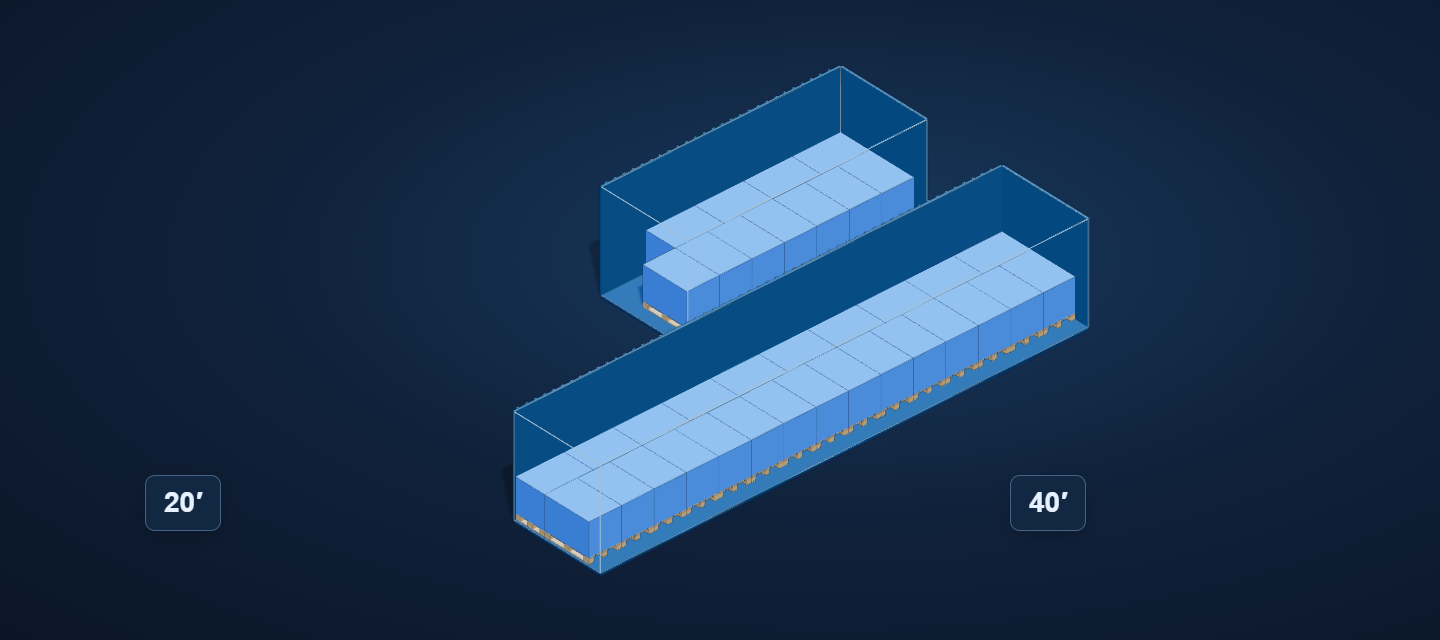
To analyze loading geometry, you can use Pallet3D: the tool allows you to enter cartons or rolls with dimensions and weight, arrange them on pallets, and then position the pallets in a container. The interactive 3D view supports evaluation of the prepared layout, while decisions concerning weight, stability and securing require separate operational verification.
Plan your load in 3D
Enter your box sizes and Pallet3D shows the optimal layout in interactive 3D - 5 days free.