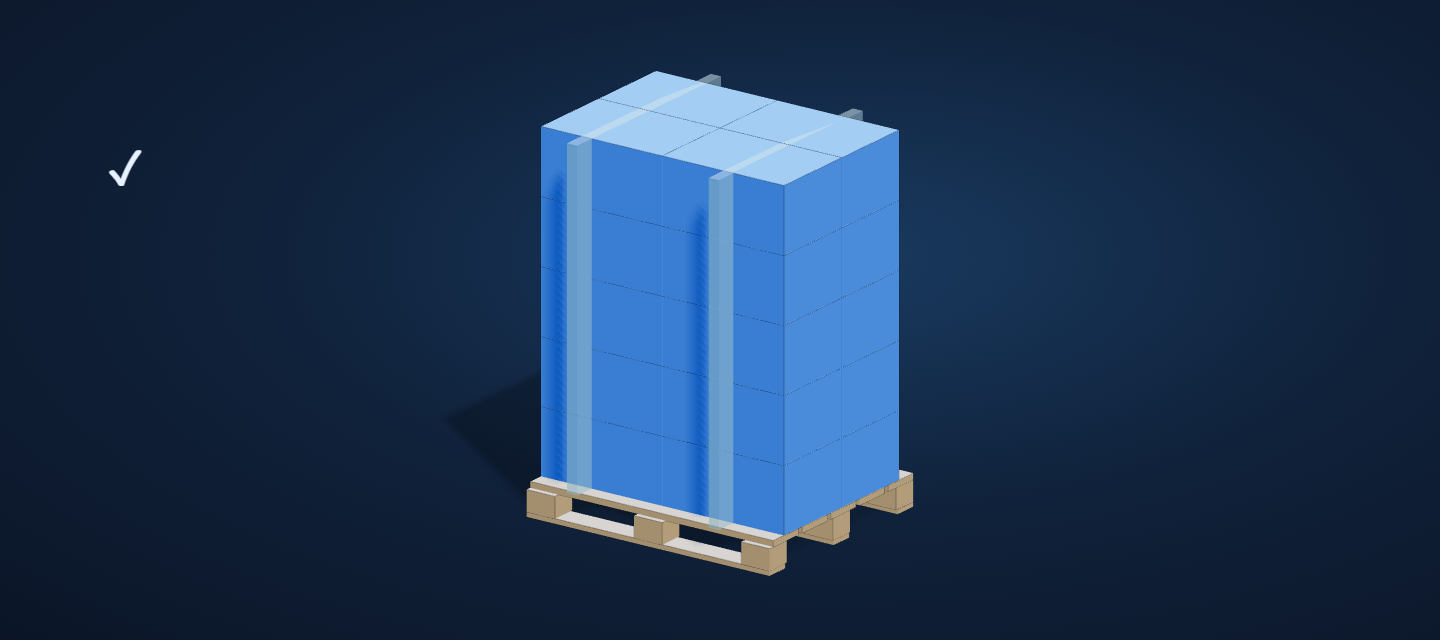
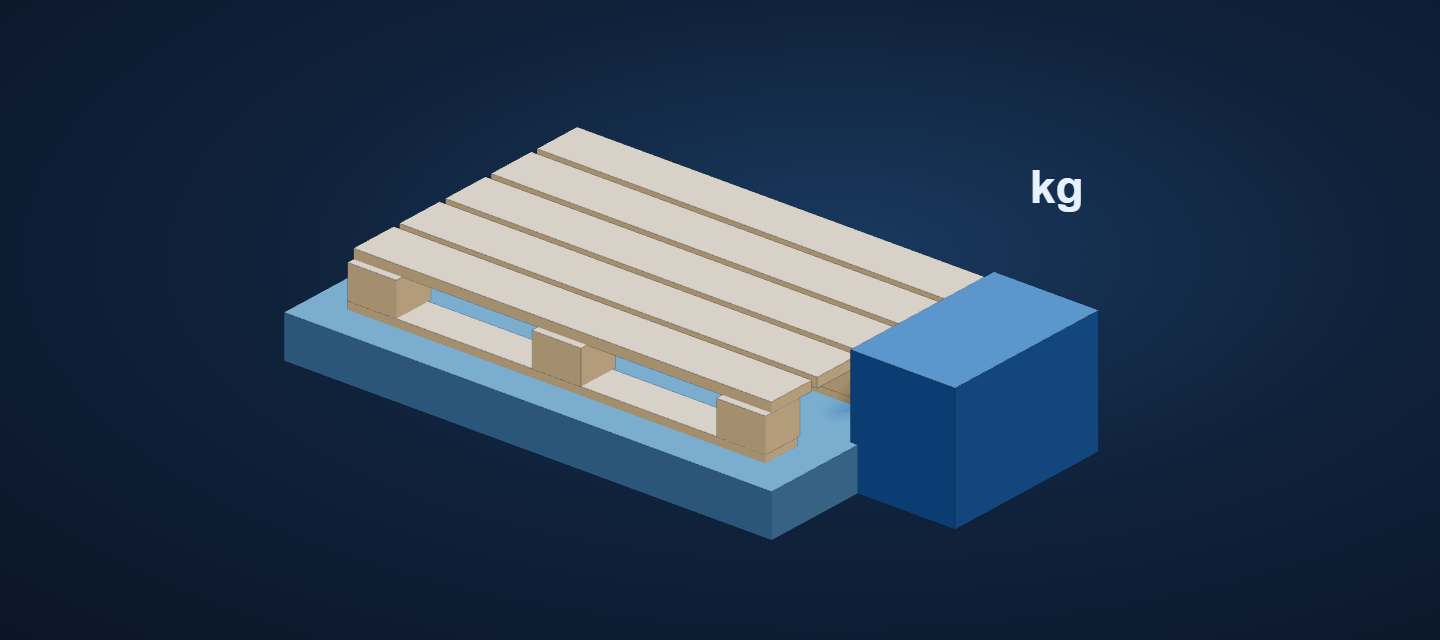
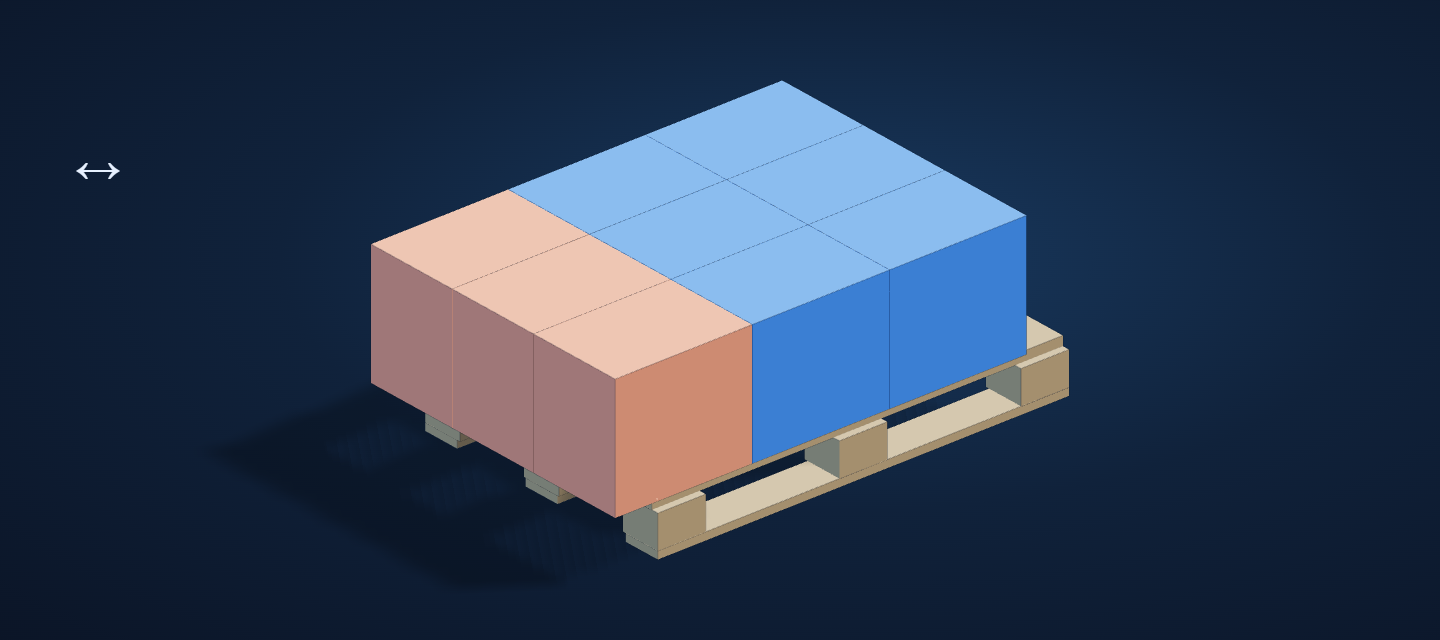
What pallet stacking is and when it makes sense
Pallet stacking consists of creating a stack by placing one pallet on another. In warehouse practice, however, the decision does not concern only whether the bases have the same format. It is equally important whether the lower unit provides an even support surface, whether the packaging will withstand pressure from above, and whether the center of gravity will remain within the outline of the base.
Before building the layers, check the box arrangement in the boxes per pallet calculator. For further worked examples, see the guide Maximum height and weight of a loaded pallet.
Stacking makes sense when the manufacturer of the goods or packaging allows such storage, the pallets are in good condition, and the operating conditions allow the stack to remain stable. The assessment should also include further actions: picking up with a forklift, moving in the warehouse area, loading, and transport. A stack that is stable on the floor may behave differently during braking, turning, or driving over an uneven surface.
The term “industrial pallet” should not be equated with a single construction standard. It is the name of a category of applications. Also, the 1200 × 1000 mm format does not automatically mean that the pallet is a certified EPAL 2 or that it has its load-bearing parameters.
What pallet load-bearing capacity and stack load mean
Before placing the first pallet, it is worth separating four issues that are often confused in everyday work. The parameter of a single pallet does not by itself answer the question of how many layers there can be or whether storage in a rack is permissible.
For EPAL 1, the safe working load is 1500 kg, and when stacking loaded pallets on a hard and level surface, the load on the lowest pallet should not exceed 5500 kg; EPAL specifies this value and its conditions of use. This is not a universal value for every pallet with dimensions 1200 × 800 mm, nor is it confirmation that a specific good can be stacked.
EPAL 2 has dimensions 1200 × 1000 × 162 mm and a safe working load of 1250 kg according to the EPAL 2 specification. However, the 1200 × 1000 mm dimension may also belong to a pallet of different construction, technical condition, and parameters. Before transferring load-bearing values to a specific unit, its markings and the documentation applicable to that pallet type should be checked.
Assessment before placing the first pallet
Safe pallet stacking begins with checking the bottom unit. The pallet should be complete, not tilted, and stably supported on the surface. Visible damage to load-bearing elements, deformation, loose parts, or uncertain pallet origin are grounds not to use it as the base of a stack without additional assessment.
Next, assess the load. The mass should be distributed as evenly as possible, and the top surface must provide support for the pallet placed above. A load shifted to one side, with a high center of gravity, or with protruding elements may cause tilting even if the pallet itself is not damaged. Special caution is required for packaging susceptible to crushing, deformation, or slipping.
The third element is the placement location. The floor should be hard, level, and suited to the planned load. When storing in a rack, the permissible load of the rack level, the placing rules, and the requirements for the handled unit must be confirmed. Do not transfer block-stacking rules to a rack without checking its documentation and work organization.
During transport, there is also the issue of load movement. It should be determined whether the stack can be secured in accordance with the adopted fastening method and whether the position of the pallets will change during starting, braking, and maneuvers. The broader context of securing assessment is described by load safety principles.
How to build a stable pallet stack
- Prepare the surface and place the bottom pallet in a stable position, without tilt and without random shims that could shift.
- Check whether the load on the bottom pallet is secured and creates a surface capable of carrying the pressure of the next unit.
- Place the next pallet centrally so that its support is complete and does not cause the center of gravity of the stack to shift.
- After placing each layer, check the vertical alignment, pallet contact, any shifts, and load protrusion beyond the outline that affects stability.
- Stop stacking when the packaging deforms, the pallet does not rest evenly, or the stack begins to tilt.
Do not level out unevenness with random elements. Spacers, additional support, film, straps, or other stabilizing measures may be used when they are intended for the given load and handling method. Wrapping with film alone does not change the load-bearing properties of the packaging or repair a damaged pallet.
In the warehouse, the stack is assessed primarily in terms of static stability and the possibility of safe picking. Stacking pallets during transport additionally requires checking how the entire arrangement is secured. After partial unloading, the remaining pallets should be assessed again, because the mass distribution and support conditions change.
Why there is no single universal stack height
There is no single safe number of pallets in a stack or common height for all products. The limit depends on the parameters of the specific pallet, the mass of each unit, the strength of the packaging, the stability of the center of gravity, the load-bearing capacity of the floor or rack, and the handling conditions. The manufacturer’s instructions for the goods or packaging may additionally completely exclude top loading.
The HSE PM15 guidelines indicate six times the narrowest dimension of the base only as an upper reference point for controlled block stacking after assessing the stack, pallet, and load. This is not a universal limit, a Polish regulation, or an automatic basis for determining the height of a stack in a warehouse or vehicle.
The practical decision should therefore begin with two questions: what load will the bottom unit carry, and does the goods on it create stable support for the next pallet? Only after these are confirmed can the geometry of the arrangement and the height available in a specific storage location or cargo space be analyzed.
When it is better to avoid stacking
Stacking should be avoided when it is not possible to confirm the load-bearing capacity of the pallet, the resistance of the packaging to pressure, or the stability of the entire unit. This applies in particular to damaged, tilted pallets or those placed on an uneven surface, as well as loads that shift, deform, or do not provide even support.
It is also risky to combine pallets solely on the basis of similar dimensions. Two pallets may have the same format but different construction, height, technical condition, and permissible load. Do not assume that a 1200 × 1000 mm pallet has EPAL 2 parameters if its markings and proper technical data do not confirm this.
The process must also be stopped when, after placing another pallet, tilting, lack of full support, increasing displacement, or deformation of boxes and other packaging is visible. Continuing to stack in order to use the available height increases the risk of product damage and a dangerous situation during picking or transport.
Practical checklist before approving the stack
- Check the pallet type, its markings, and the condition of the load-bearing elements.
- Confirm the pallet load-bearing capacity and the permissible load on the bottom unit for the planned arrangement.
- Verify whether the manufacturer of the goods or packaging allows top loading.
- Assess the evenness of the mass distribution, the center of gravity, and the securing of the load against shifting.
- Check the hardness, evenness, and load-bearing capacity of the surface or the parameters of the rack level.
- After placing each pallet, check the vertical alignment of the stack, full support, and load protrusion beyond the outline.
- During transport, confirm the possibility of securing the stack and repeat the assessment after partial unloading.
Visual verification of the stacking variant
After confirming the load-bearing capacity of the pallets, packaging, and process rules, you can check the arrangement variant in Pallet3D. This single calculator runs in the browser, allows you to plan pallet layouts, and presents the result in an interactive 3D view. The visualization helps assess the geometry of the plan, but it does not replace confirmation of mass, pressures, stability, or the method of securing the load.
Check the stacking variant after confirming the load-bearing capacity of the pallets, packaging, and process conditions.
Plan your load in 3D
Enter your box sizes and Pallet3D shows the optimal layout in interactive 3D - 5 days free.
Open the calculator →